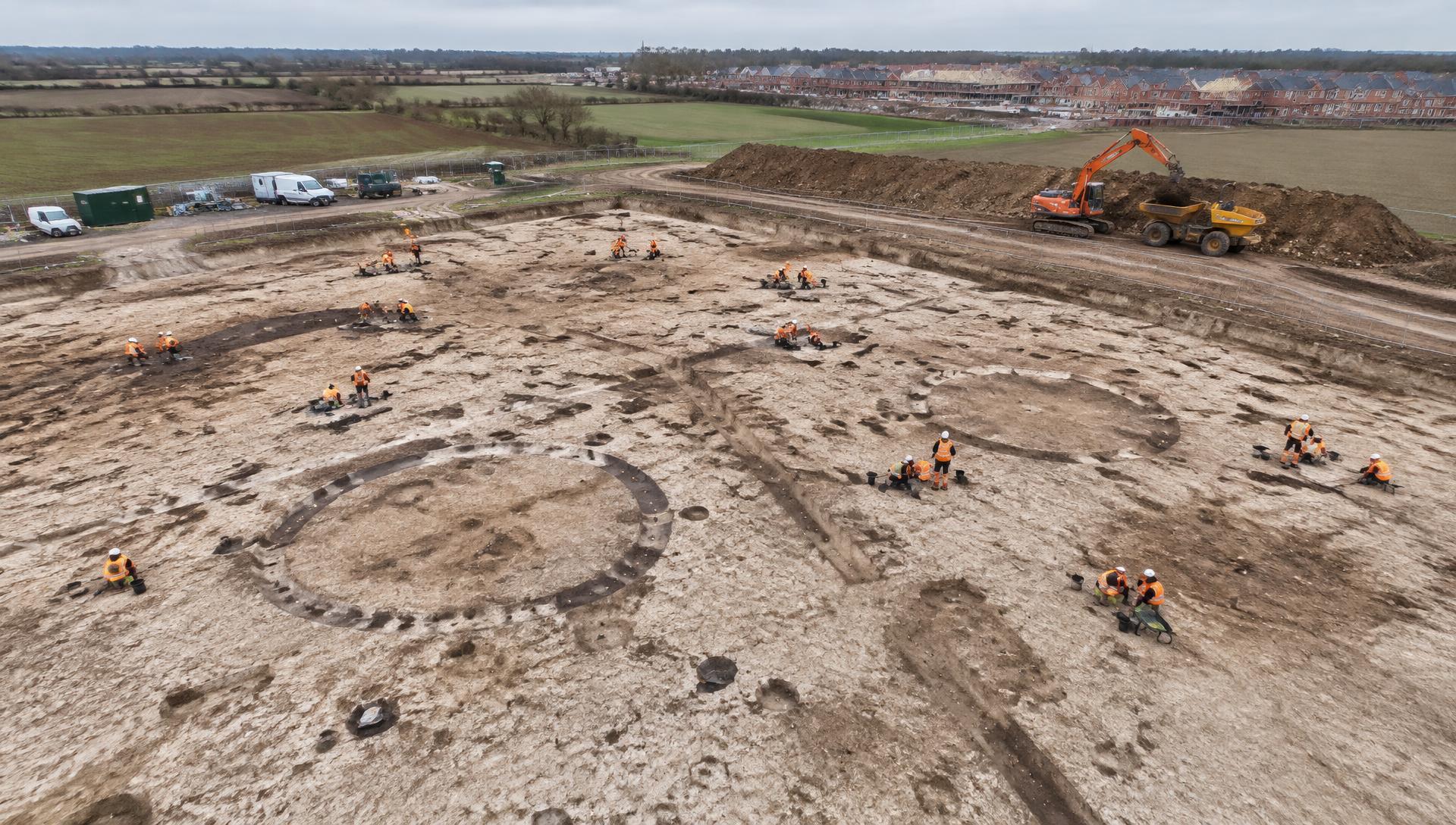
Cambridge · Cambridgeshire · East of England
Commercial Archaeology for Major Developments in Cambridge
Development-led archaeological evaluation, mitigation and excavation for major housing, infrastructure and commercial projects across Cambridge and Cambridgeshire.
- Who we work for
- Developers, housebuilders, land promoters, planning and environmental consultants, contractors and infrastructure clients.
- Project scale
- Multi-stage archaeological programmes on sites from a single hectare to large strategic allocations.
- Where we work
- Cambridge and Cambridgeshire, with delivery across the East of England for substantial schemes.
Start with your decision
Which archaeological decision is holding the project?
Before acquisition or application
Establish the evidence, impacts and uncertainty before fixing the land appraisal.
Assessment scope →An issued condition or brief
Separate the HER evidence, adviser requirement and written approval needed for the next stage.
Brief and approval sequence →A tender or live construction deadline
Issue comparable scope, release dates and reporting obligations; flag urgent work in the review form.
Procurement checklist →Development programme first
Archaeology is a programme problem before it is an archaeological one
Most of our clients are not looking for archaeology. They are holding a planning condition, an evaluation requirement or a construction start date, and they need the archaeology resolved in a way that protects the wider development timetable.
- We scope archaeological work against your planning position, not against a generic service list.
- We set out sequence, duration, resourcing and reporting before fieldwork is committed, so the archaeology can be programmed alongside enabling works.
- We deal directly with the local authority archaeological advisor so the scope agreed is the scope that discharges the condition.
- Where archaeology proves more extensive than expected, we quantify the programme and cost consequences early rather than at the point of overrun.
Capability
A single team across the full archaeological sequence
Development archaeology rarely stops at one stage. We are structured to carry a site from first assessment through to condition discharge without handing your programme between suppliers.
- 01
Assessment & appraisal
Desk-based assessment and site appraisal to establish archaeological risk before land acquisition or planning submission.
- 02
Evaluation
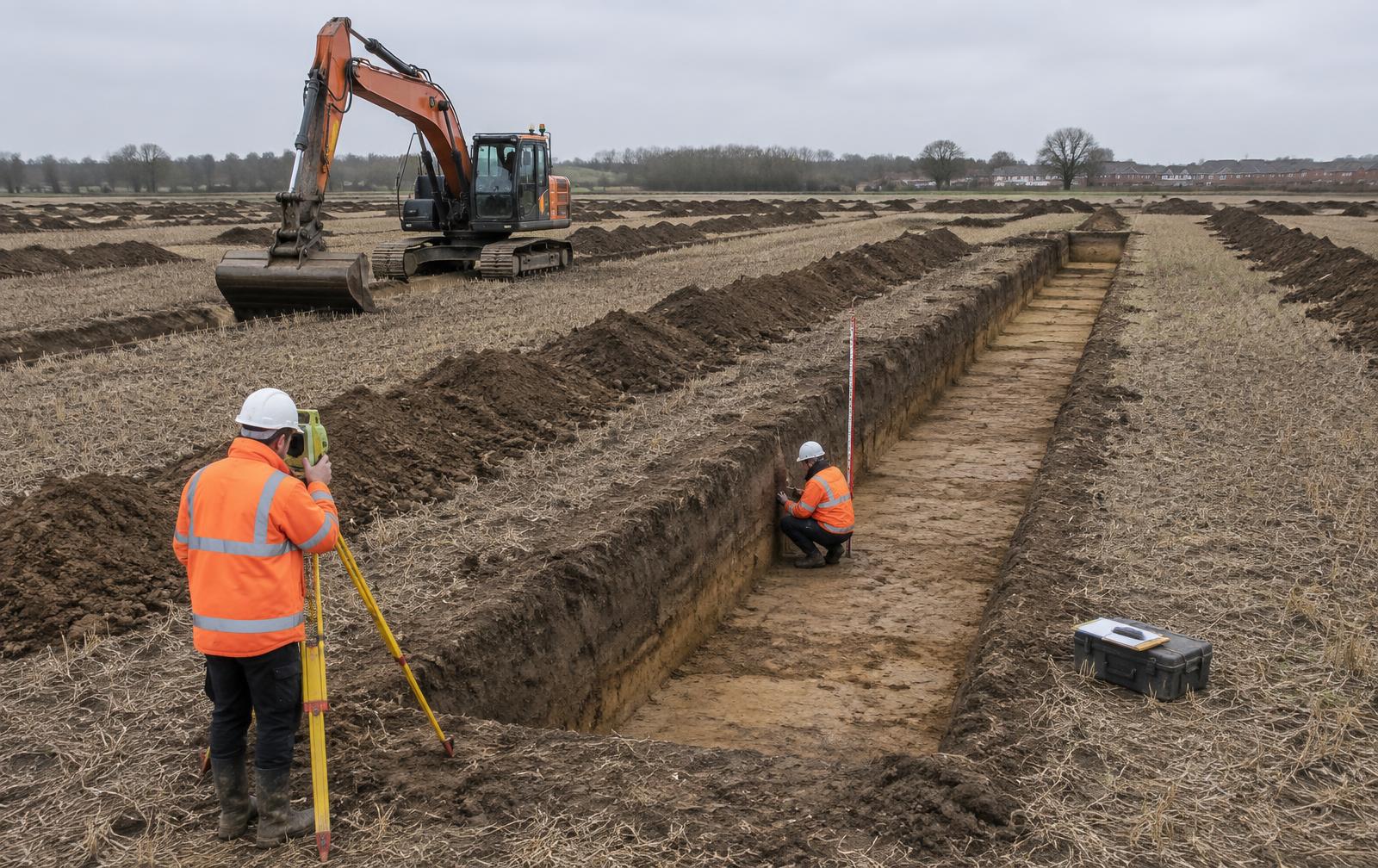
Geophysical survey and trial trenching to define what is actually present, where, and to what significance.
- 03
Mitigation & excavation
Mitigation strategy, targeted or open-area excavation, strip, map and sample, and monitored groundworks.
- 04
Reporting & discharge
Post-excavation assessment, analysis, archive and the reporting the authority needs to sign the condition off.
Services
Where developments usually need us
Each of these is a distinct commercial decision point, with a different cost, duration and programme consequence.
Evaluation & trial trenching
Pre-determination and pre-commencement evaluation that establishes the real extent of archaeological risk on your site.
Read more →Archaeological mitigation
Mitigation strategies and delivery — targeted excavation, strip, map and sample, and monitored groundworks.
Read more →Large-scale excavation
Open-area excavation resourced and programmed for multi-hectare development sites.
Read more →Planning conditions
Written Schemes of Investigation, regulator agreement and evidence for condition discharge.
Read more →Development risk guidance
Answers for the decisions that hold up sites
These are the points where an archaeological requirement becomes a land, procurement or construction-programme decision. Each guide explains the next decision and the evidence needed to make it.
Evaluation result
Trial trenching found archaeology: what happens next?
The decisions between a positive evaluation report, mitigation scope, design response and a dependable construction start.
Read the guidance →Groundworks
When is an archaeological watching brief enough?
Where monitored groundworks are proportionate, where they move risk into construction, and what the approved scheme must settle.
Read the guidance →Commercial risk
Who pays for archaeology on a development site?
How cost is normally allocated between landowner, promoter, developer and contractor—and where disputes start.
Read the guidance →Programme
How archaeology fits the construction programme
The approval, fieldwork, reporting and handover stages that need real float in an enabling-works programme.
Read the guidance →Sectors
Built around the development types that generate archaeology
Cambridgeshire's growth — strategic housing allocations, science and life-science campuses, energy generation, minerals and infrastructure — sits on some of the richest buried archaeology in England.
Housing development archaeology
Strategic allocations, masterplanned schemes and phased residential delivery, where archaeology has to be sequenced against plot release and infrastructure works.
Read more →Major development & infrastructure
Linear schemes, utilities, energy generation and battery storage, minerals, commercial and science park development, and tendered contractor packages.
Read more →Accountable expertise
A named archaeologist behind the work
Adrian Wellard founded Cambridge Development Archaeology after practical archaeological fieldwork and supervisory experience from 2018 onward. Clients have a direct line to the archaeologist responsible for understanding scope and coordinating delivery.
See Adrian’s field capability, technical experience and approach to development-led archaeology.
Adrian Wellard — profile →Tools & local reference
Work out where your site stands before you call anyone
Two free tools and a reference library covering every Cambridgeshire planning authority, the growth locations generating most of the county's archaeology, and the development types that trigger it.
Planning condition decoder
Paste the archaeological wording from your decision notice and see what is actually required, in what order, and what has to happen before you can start on site.
Open tool →Cost & scope worksheet
Identify evidence gaps, budget stages and approval questions before requesting a site-specific price.
Open tool →- How much does archaeology cost per hectare?
- How long does archaeology delay a development?
- Who pays for archaeology on a development?
- What happens if archaeology is found during construction?
- Can archaeology be preserved in place instead of excavated?
- What if an archaeological condition is already overdue?
- Do we need archaeological advice before buying the land?
Project review
Send us the planning condition, the brief or the site plan
Tell us where the site is, what stage it has reached and what has been asked for. We will come back with the archaeological position, the likely sequence and what it means for your programme.