Evaluation & trial trenching
Archaeological evaluation and trial trenching
Evaluation converts an unquantified archaeological risk into a defined scope of work. It is the stage at which a development can still change its mind cheaply — about layout, about phasing, and about how much mitigation it is prepared to carry.
- Stage
- Pre-determination or pre-commencement
- Methods
- Geophysics, trial trenching, test pitting
- Output
- Evaluation report and mitigation position
- Decides
- Extent and cost of mitigation
Purpose
Evaluation is a risk-pricing exercise, not a search for discoveries
The commercial question an evaluation answers is not 'is there archaeology here'. It is 'how much of this site will need mitigation, how long will that take, and what will it cost'.
- Defines the presence, extent, date, character and significance of buried remains across the development area.
- Establishes which parts of the site are constrained and which can proceed with little or no further archaeological work.
- Provides the evidence base the local authority archaeological advisor needs to set a proportionate mitigation requirement.
- Gives you a defensible cost and programme assumption for the mitigation stage, before it is committed.
- Where results are negative, it can remove archaeology from the programme entirely.
Scope
What an evaluation package normally contains
- Baseline
- Historic Environment Record data, historic mapping, aerial and LiDAR review, and any previous archaeological work on or adjacent to the site.
- Geophysical survey
- Magnetometer survey across the development area, used to target intrusive work and reduce unnecessary trenching.
- Trial trenching
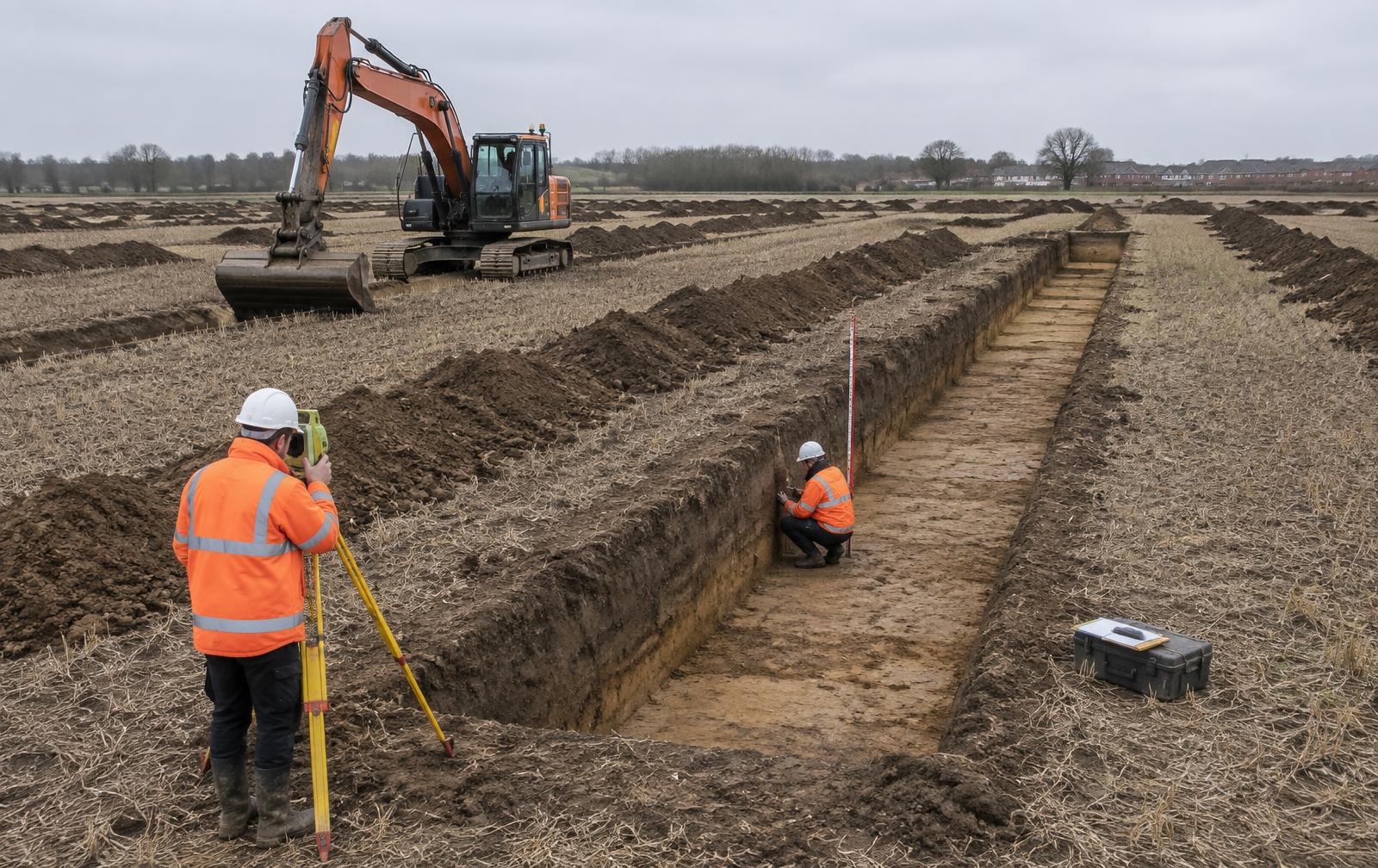
- Machine-excavated trenches to the agreed sample, hand-excavated sampling of features, full recording, survey and environmental sampling.
- Reporting
- Evaluation report setting out results, significance and a recommended mitigation position, issued to you and to the authority.
- Programme inputs
- Trench schedule, plant requirement, access and welfare requirements, and a realistic fieldwork window for your programme.
- Site logistics
- Access, ecology and services constraints, reinstatement, and coordination with other site investigations wherever possible.
Sequence
From brief to mitigation position
- 01
Brief and scheme
We review the authority's brief, agree the trench layout and sample, and prepare the Written Scheme of Investigation for approval.
- 02
Non-intrusive survey
Geophysical survey where it will add value, used to refine trench positions before machines are booked.
- 03
Trenching
Machine excavation and archaeological recording to the approved scheme, with daily progress reporting against the programme.
- 04
Results and position
Interim results as soon as they are known, then the report and a clear statement of what mitigation the site is likely to require.
Common questions
Evaluation and trial trenching: common questions
How long does archaeological trial trenching take?
Fieldwork duration is driven by trench metreage, machine availability, ground conditions and how much archaeology is present. A modest site may be days; a large allocation trenched at a standard sample percentage can run for several weeks, with reporting afterwards. The reporting stage is the part most often left out of development programmes.
What percentage of a site is normally trenched?
The sample is set by the local authority archaeological advisor in the brief or approved scheme, and reflects the site's known potential and the development's impact. Published sample figures are a starting point for discussion, not a fixed rule, and we would not quote one for your site without seeing the brief.
What happens if trial trenching finds archaeology?
Finding archaeology at evaluation stage is a normal, manageable outcome — that is what evaluation is for. The results define the mitigation requirement: its extent, its likely method and its cost. The commercially damaging scenario is not finding archaeology at evaluation, it is finding it during construction.
Is geophysical survey an alternative to trenching?
Usually it is a complement, not a substitute. Geophysics covers large areas quickly and targets where trenches should go, but it does not date or assess significance, and in some Cambridgeshire geologies it under-reports. Most authorities expect intrusive evaluation before mitigation is agreed.
Can evaluation be done before planning permission?
Yes, and on sensitive sites it is frequently required. Pre-determination evaluation means the application is decided with the archaeological position understood, which reduces the risk of onerous conditions and of the scheme being redesigned late.
Project review
Send us the evaluation brief
If an authority has issued a brief or asked for pre-determination evaluation, send it over with the site boundary. We will set out the trench requirement, the fieldwork window and what it means for your submission date.